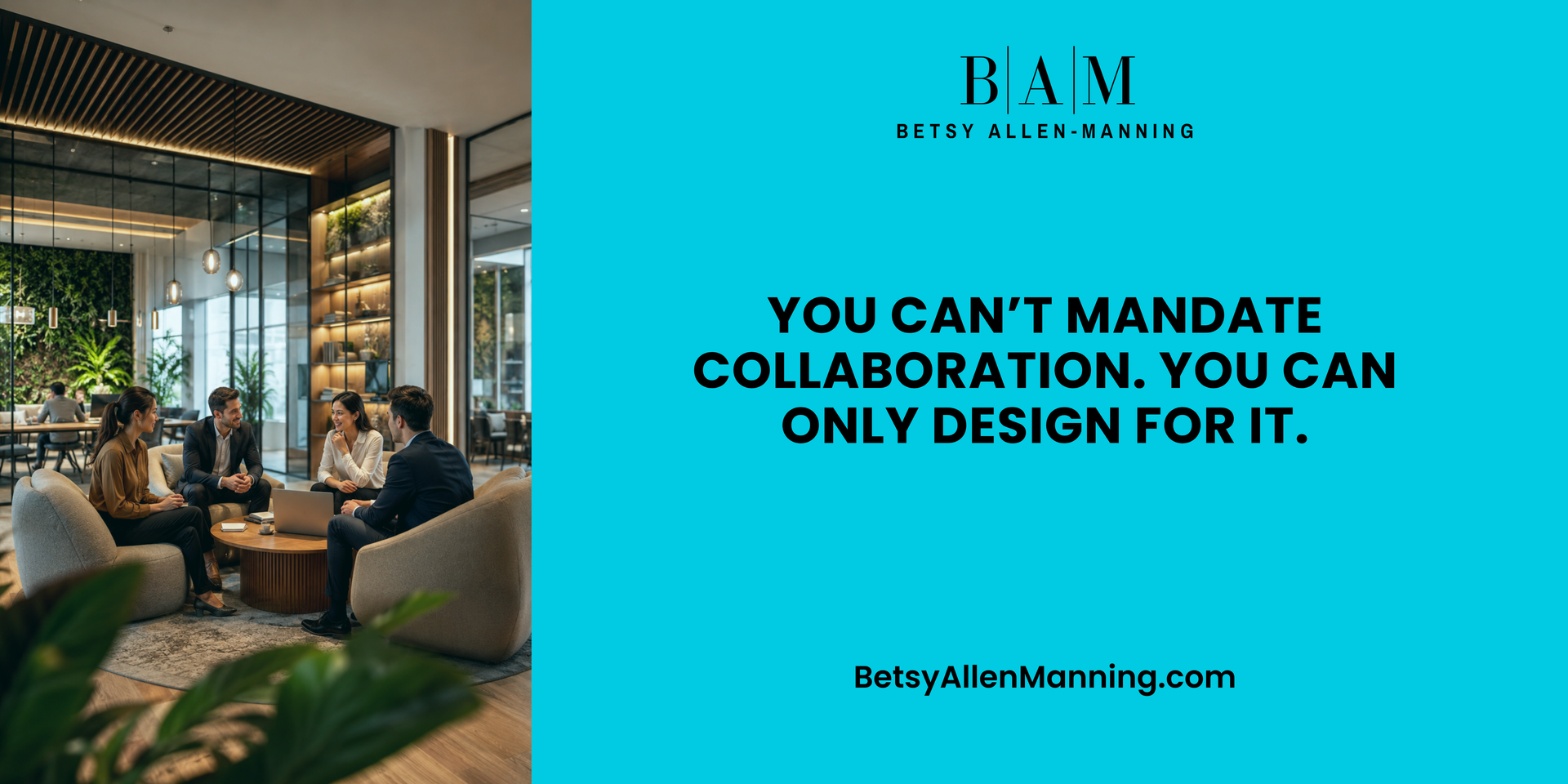
You Can’t Mandate Collaboration. You Can Only Design for It.
A tech company I once worked with brought everyone back to the office after Covid. They had no plan, no purpose, just bodies in chairs. Months later, they ran the numbers and found out most of their people had actually been more productive at home. So what did the mandate buy them? A parking problem and a room full of resentment. They created a ‘coffee-badging’ culture. (Explained below.)
They weren’t wrong to want their people together. They were wrong about what actually brings people together.
First, Let Me Explain Coffee Badging
Coffee badging is when an employee swipes into the building, gets seen, grabs a coffee, hangs a jacket on the back of a chair… and leaves. The badge log says they complied. They were there for 40 minutes.
46% of workers under a return-to-office mandate admit they do it, according to a
survey of 1,000 full-time U.S. employees by Enhancv. Samsung
built a tracking tool specifically to catch it.
But coffee badging isn’t a discipline problem. It’s a review.
Those employees walked in, looked around, found nothing in that building worth staying for, and left. They’re telling you the room has no reason to exist. And leaders are responding by buying better scanners.
Meanwhile, a
University of Pittsburgh study tracking more than three million employment records across S&P 500 firms found that return-to-office mandates drove a 14% jump in departures. Among top managers, 19%. Those are the people you can least afford to lose, and they’re the ones with the most options.
Talent Fills a Team. Somebody Has to Unite It.
There’s a trait in the Bar Raisers™ DNA built exactly for this moment, and it’s called ‘Intentional Unifier’.
An
Intentional Unifier deliberately connects people, breaks down silos, and turns a group of individuals into a team that works as one. They pull in the person on the outside. They introduce two people who should know each other. They defuse the tension that nobody wants to acknowledge.
Notice the word doing all the heavy lifting there. Intentional. Not accidental. Not proximate. Not “we’ll all be in the same zip code, so surely something will happen.”
Leaders: You’re Measuring the Wrong Thing
A badge scanner tells you who showed up. It never tells you who contributed.
And the difference matters more than most leaders think. In our
National Workplace Trends Study, the single highest-ranked leadership factor that would convince someone to stay at a job longer was this: your manager ensures you get credit for the work that you did. 36% ranked it first.
Not presence. Credit for contribution.
The fix: Stop asking where your people are. Start being able to name, out loud, the specific thing each person on your team moved forward last week. If you can’t, that’s not a them problem. That’s a you’re-not-watching-closely-enough problem.
Teams: Silos Survived the Return
89% of American workers say it’s important to feel like they’re part of a team, according to our National Workplace Trends Study.
That number doesn’t change based on where the desk is. Which is exactly why bringing people back didn’t fix it. You can put nine people in one room and still have nine teams of one, all heads-down, all in their own lane, all wondering why they got up at 5:30 for this.
The fix: Give the gathering a job. Before any in-person day, name the one thing that can only happen because these specific people are in the same room. If you can’t name it, you didn’t need the room.
Culture: Compliance Isn’t Buy-In
Almost 1 in 3 American workers, 29%, would not recommend their workplace to someone else (National Workplace Trends Study).
They’re still showing up. They’re badging in. Their attendance is beautiful. That’s the trap. A leader can look at a full floor and read it as a culture win, when what they’re actually looking at is a group of people who have decided this is a paycheck and nothing more.
Bar Raisers™ don’t settle for that. They lead for a purpose over a paycheck, and they build workplaces where other people can too.
The fix: Ask people what would make coming in worth it, and then actually build the thing they tell you.
Develop What We Call an “Intentional Unifier”
Here are three ways to develop them, and none of them involve trust falls.
1. Schedule connection like you schedule revenue.
Give it a time, an owner, and an outcome. Connection that isn’t on a calendar doesn’t happen remotely… and it doesn’t happen in the office either.
2. Give the gathering a job. Run a Collaborate and Innovate Session. Everyone brings a real challenge they’re currently facing. The room brainstorms solutions together. That’s it. No icebreakers, no ropes course, no laminated values poster. Just actual work that nobody in that room could have done alone.
3. Make contributions visible. Credit, in writing, where the whole team can see it. This is the one thing badge data will never give you, and it’s the exact thing your people say they stay for.
Tomorrow’s Move: The Purposeful Day Test
Before your next required in-office day, write down the one thing that can only happen because these people are in the same room.
Not “collaboration.” Not “culture.” One specific thing.
If you can’t fill in the blank, cancel the day and give it back to them. You’ll earn more trust in that one email than you will in a year of badge reports.
Remember, talent may fill a team, but only a Bar Raiser™ unites it.
Let’s keep raising the bar together! 💪
Ready to build a team that actually works as one? Bring Betsy to your next event to help unite your team. 👉
https://www.betsyallenmanning.com/contact
About Betsy: Betsy Allen-Manning is the wake-up call you didn’t know you needed. She’s a high-energy leadership keynote speaker and creator of the Bar Raisers™ Movement: a proprietary system redefining how organizations are approaching performance, leadership, and culture. Featured on FOX, CBS, NBC, ABC, and TEDx, Betsy works with organizations across corporate, franchise, association, nonprofit, and government sectors. She’s the lead researcher behind the National Workplace Trends Study, and delivers programs around her Bar Raisers™ and Leadership Mastery frameworks. She is the founder of Destination Workplace®, an award-winning leadership development firm in Dallas, Texas.